
Mediation has evolved from an alternative dispute resolution mechanism into a cornerstone of modern legal practice, one that unites reasoning with empathy. Across Asia, and increasingly in Vietnam, mediation has become not just a tool for settling conflicts but a bridge between cultures, values, and communication styles.
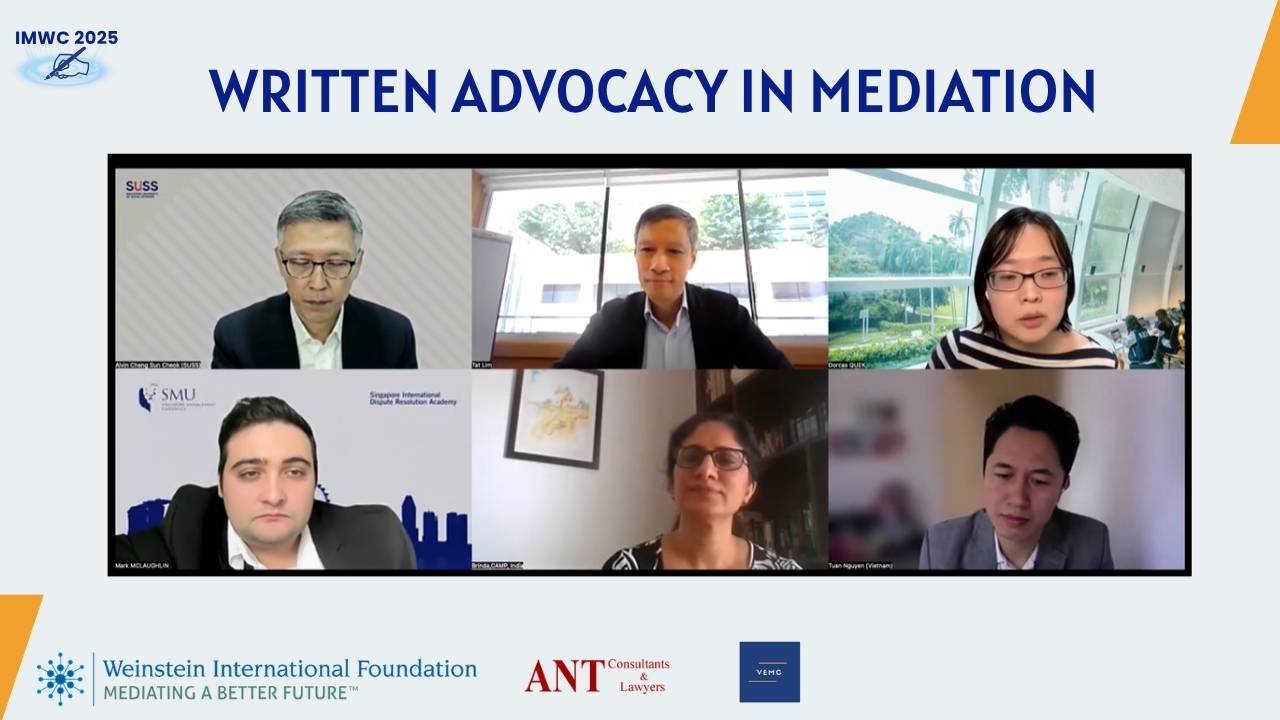
During the Weinstein International Mediation Writing Competition Webinar held in Singapore, experts from Singapore, India, and Vietnam gathered to explore the theme “Written Advocacy in Mediation.”
The discussion highlighted that mediation writing is not simply about argumentation, it is about awareness, tone, and cultural intelligence, especially within the growing field of cross-cultural mediation in Vietnam.
The webinar was moderated by Mr. Tat Lim, Singapore Senior Fellow of the Weinstein International Foundation (WIF), and featured Associate Professor Alvin Cheng (Singapore University of Social Sciences), Associate Professor Dorcas Quek Anderson and Assistant Professor Mark McLaughlin (Singapore Management University), Mr. Tuan Nguyen, Vietnam Senior Fellow, WIF, and Ms. Brinda Uthaiah (CAMP Arbitration and Mediation Practice).

Watch the full webinar here: Written Advocacy in Mediation
Together, the panelists explored how young advocates can write persuasively and ethically across cultural boundaries while fostering mutual respect and collaboration.
How Written Advocacy in Mediation Differs from Litigation
The first and most important distinction lies in the audience.
In litigation, the lawyer writes to persuade a judge, the ultimate decision-maker. In mediation, however, the mediator does not impose a judgment. The brief must speak to everyone involved, the mediator, the opposing counsel, and their clients.
The goal is not to “win” but to build understanding and cooperation. As Professor Dorcas explained, a mediation brief should demonstrate that the advocate understands multiple perspectives and is willing to find common ground.
The second difference lies in content.
While court pleadings are bound by legal facts and rules, mediation briefs must also acknowledge emotions, relationships, and human context.
In cross-cultural mediation in Vietnam, this broader approach is especially relevant, where cultural respect, hierarchy, and diplomacy shape how conflicts are expressed and resolved.
The Tone and Culture: From Adversarial to Collaborative
In litigation, tone often divides. In mediation, tone connects.
As Professor Alvin emphasized, the language of mediation should invite collaboration, not confrontation. The right tone opens dialogue while the wrong one shuts it down. He likened a mediation brief to a “first impression”, one that can either build trust or create distance.
Tuan Nguyen added that in cross-cultural mediation in Vietnam and across Asia, communication must account for cultural norms of respect and face saving. What sounds confidently assertive in Western cultures may feel blunt in Vietnam, while indirect phrasing, often meant as politeness, may be mistaken for hesitation elsewhere.
Balancing clarity with cultural empathy helps advocates express firmness without aggression and respect without ambiguity, a skill crucial to maintaining dialogue in multicultural settings.
From Brinda Uthaiah echoed these views, describing mediation writing as “setting the stage” for constructive conversation. She noted that a well-prepared mediation brief should reflect openness and sincerity, signaling a genuine willingness to understand the other side.
Setting the Stage: Realism, Credibility, and System Thinking
Moderator Tat Lim emphasized that effective mediation advocacy begins with realism and credibility. Lawyers, he cautioned, often exaggerate their strengths while minimizing their weaknesses, which can erode trust.
Instead, he encouraged participants to write with fairness, sincerity, and measured confidence. When the mediator and the opposing side see you as someone they can do business with, cooperation becomes possible.
Tuan Nguyen expanded on this point by drawing inspiration from Professor Janet Martinez at Stanford Law School and co-author of Dispute System Design: Preventing, Managing, and Resolving Conflict, where she stressed that mediation design should consider not only the disputing parties but also the wider community of stakeholders, including investors, suppliers, and the public.

This perspective aligns closely with cross-cultural mediation in Vietnam, where business relationships, family ties, and social harmony often intertwine. By recognizing mediation as a system of relationships, advocates can craft solutions that endure beyond a single settlement.
Together, the message is drawn from the discussion that, written advocacy in mediation is not just about persuasion, it is also about responsibility, foresight, and human connection.
The Purpose of a Mediation Brief
According to Professor Alvin, a mediation brief serves two purposes:
To inform: clarifying the client’s position, interests, and expectations.
To persuade: inviting others to see the dispute from a collaborative perspective.
Practitioners often prepare both an open brief (shared with the other side) and a confidential brief (for the mediator only).
This dual structure helps mediators guide discussions effectively while protecting sensitive information, a method especially valuable in cross-cultural mediation in Vietnam, where discretion and personal rapport are key to progress.
Writing with Clarity and Persuasion
Professor Mark reminded students that persuasive mediation writing relies on clarity and balance.
The best advocates are those who persuade not through confrontation but through reason and fairness.
Acknowledging the other party’s legitimate interests, can be one of the most powerful tools in building credibility.
In cross-cultural mediation in Vietnam, this form of calm, respectful reasoning mirrors the nation’s deep rooted values of harmony and understanding
Conclusion
Mediation is more than an alternative to litigation, it is a philosophy rooted in empathy, communication, and creativity.
For future young legal practitioners, true advocacy means writing like a bridge builder, one who connects perspectives, respects differences, and finds strength in understanding.
As this practice grows, it continues to prove that words, when written with empathy and integrity, can build peace that lasts longer than any verdict.
About VEMC, a Mediation Center in Vietnam
Vietnam Effective Commercial Mediation Center (VEMC) is a a Non-Profit Organization that Promote Mediation as Alternative Dispute Resolution in Vietnam, Provide Training and Mediate Disputes. The idea of mediation is to offer a different way of handling disagreements as compared to litigation proceedings. At VEMC, we pride ourselves on having a team of highly qualified and experienced professionals dedicated to the vision and mission of the center. Contact us to exchange ideas for cooperation in dispute resolution, work with us, or request services.